I have had this conversation three times this week, so I think it is time to write about it. Many of my clients are not aware that they can tour their potential hospital.
The main benefit of touring the hospital is taking out the element of surprise. It’s like picking out a wedding venue for your big day – you want to be able to picture it as you prepare. Even if you are not shooting for a natural birth, it is still nice to take a look at the room, know what tools they have available for you in labor, get a feel for the nursing staff, etc. So go take a tour of the hospital facility if you have never labored there before!
I’ve been on a slew of home visits lately, where mom is worried about baby not being back to birth weight at 2 week appointment. I am going to copy and paste a great fact sheet from La Leche League’s website:
Is My Baby Getting Enough Milk?
From New Beginnings, Vol. 25 No. 5, 2008, pp. 44-45
Whether or not baby is getting enough milk is one of the most common concerns of new moms. Since we don’t have measurement markers on our breasts, we can’t initially “see” that our babies are really getting the milk they need. You can tell baby is getting enough milk, however, by keeping track of dirty diapers, weight gain, and appearance.
Breastfeed Often
A baby needs to breastfeed frequently. Your milk is digested quickly and easily, sometimes in as little as 60 minutes, and small amounts are perfect for baby’s tiny stomach. These frequent feedings also help to establish your milk supply. In simple terms, the more milk that is removed from your breasts, the more milk your body will produce. Frequent feedings are good for both of you!
A newborn should feed at least eight to 12 times in a 24-hour period.
Allow baby to determine the length of feedings: 10 to 20 minutes per breast or longer.
Keep in mind that some babies “cluster nurse,” which means that they nurse very often for a few hours and then sleep for several hours. The number of feedings in a 24-hour period is more important than the spacing of feedings.
A sleepy baby may need to be wakened every two to three hours to feed, particularly if he has jaundice. Talk with your health care provider if baby is lethargic and difficult to wake for feedings.
Weight Gain
age
weight gain per week
0-3 months
4-7 ounces (110-200 grams)
4-6 months
4-5 ounces (110-140 grams)
6-12 months
2-4 ounces (60-110 grams)
Weight Gain and Appearance
Your baby may lose up to seven percent of his birth weight during the first three or four days. Once your milk “comes in,” expect your baby to begin gaining weight. He should regain his birth weight by the time he is 10 to 14 days old.
You also know your baby is getting enough milk by noting that his skin color is good, his skin is firm, and he is filling out and growing in length and head circumference. Your baby should also be active and alert.
Watch Baby, Not the Clock
Watch your baby for signs of hunger, not the clock. Follow baby’s feeding cues and do not try to schedule feedings or limit feedings. Early hunger cues include:
Baby opening his mouth and moving his head side to side (known as the rooting reflex).
Baby making sucking motions with his mouth.
Baby begins to chew or suck on his hands or fingers.
Don’t wait for your baby to cry to let you know he is hunger. Crying is a very late hunger cue.
Diapers
Counting your baby’s diapers can be a helpful indicator as to whether or not he is getting enough of your milk.
baby’s age
mother’s milk
wet diapers/24 hrs
dirty diapers/24 hrs
1-2 days
colostrum (provides immunities and helps with jaundice)
At least 3-5 very loose stools; bright yellow color that are about 2.5 cm
6 weeks
milk supply established
Same as 2-6 days
Some babies switch to less frequent but large bowel movements
Increasing Your Supply
Mothers throughout the ages have been able to produce plenty of milk for their babies. In certain situations because of a health problem or other complication, a mother may have a reason to be concerned and may need to carefully monitor her baby’s weight gain in order to be sure he is getting enough milk. If baby is not gaining well or he is losing weight after the first few days, contact baby’s health care provider. Slow weight gain may indicate a serious health problem. If you’re concerned about your milk supply, get help. Being in touch with a La Leche League Leader can often provide the information, support, and encouragement that mothers need to be reassured that they are providing plenty of milk for their babies. Steps that will help your baby get as much of your milk as possible include:
Nurse often for as long as your baby will nurse. The more milk that is removed from the breast, the more milk the breast will make to replace it. Frequent breastfeeding helps to establish a plentiful milk supply. A sleepy baby may need to be awakened and encouraged to nurse more frequently. A baby who nurses for excessively long periods may not be nursing efficiently. If you’re experiencing this, have a breastfeeding session observed by an experienced LLL Leader or lactation professional.
Offer both breasts at each feeding. This will ensure that your baby gets all the milk available and that both breasts are stimulated frequently. Allow your baby to indicate he is finished on the first breast, then offer the other breast.
Check baby’s positioning and latch. Breastfeeding should not hurt. Hold baby close with his whole body facing you so he does not have to turn his head. When he opens his mouth wide, his head should be slightly tilted back with his nose at the level of your nipple. As he approaches the breast with his head slightly tilted back, this will bring him to the breast chin first. This will help you better aim his lower jaw so that he covers more of your breast with his lower jaw than with his upper mouth. As you bring baby onto the breast, aim your nipple toward the roof of his mouth. If you feel comfortable and baby is nursing actively, the latch is good.
Try breast compression to keep your baby interested in breastfeeding. Squeeze the breast firmly with your thumb on one side and fingers on the other to increase milk flow. Keep squeezing until baby is no longer actively sucking, then release. Rotate fingers around the breast and squeeze again. Then switch to the other breast, using both breasts twice at each feeding. Squeeze firmly but be careful not to cause injury to your breast tissue.
Feed your baby only your milk. If your baby has been receiving formula supplements, do not cut these out abruptly. As you improve your breastfeeding techniques with the help of a lactation professional, and as your milk supply increases, you will be able to gradually reduce the amount of supplement. Monitor baby’s weight gain and stay in touch with your baby’s health care provider during this transition.
All your baby’s sucking should be at the breast. If some supplement is necessary, it can be given by spoon, cup, or with a nursing supplementer. Be aware that a pacifier can create more problems than it solves. If you decide to give your baby a pacifier, wait until he is nursing effectively and gaining well.
Use skin-to-skin contact. It may encourage your baby to nurse more often. Skin-to-skin means that baby will be nestled upright between your breasts, clad only in his diaper directly against your skin. Your warmth, smell, and heartbeat will also soothe baby, which in turn aids in his development.
Try to relax. Paying attention to your need for rest, relaxation, and proper diet will help your milk supply and improve your general sense of well-being.
Talk to your health care provider about medicinal herbs or prescription medications to increase your milk supply. A La Leche League Leader can provide references with information about herbs and medication.
If you have concerns…
Some mothers think their babies are not getting enough milk when they are actually getting plenty of milk. Some “false alarms” that worry mothers include:
Your breasts feel different. If your breasts suddenly feel softer or your breasts no longer leak between feedings, it does not mean that you are producing less milk; it simply means that your supply has adjusted to your baby’s needs.
Baby seems fussy. Many babies have a fussy time every day that is not related to hunger. Some babies need lots of stimulation and activity; others need soothing. You will learn how to respond to your baby as you find the ways that comfort him. If your fussy baby settles down when you offer him the breast, go ahead and breastfeed. But don’t take this as a sign that he is not getting enough to eat.
Baby suddenly wants to feed more often, or seems hungry again soon after being fed. Babies often go through “growth spurts” when they are two to three weeks old and again at six weeks and three months. At these times, breastfeed as often as possible as your supply catches up with baby’s demand.
Baby decreases his nursing time, perhaps down to five minutes or so at each breast. As babies get older, they become very efficient at taking the milk so this is a positive sign that breastfeeding is going well, not something to worry about.
La Leche League Leaders are accredited volunteers who are available to help with breastfeeding questions in person, over the phone, or online. Locate an LLL Leader near you at http://www.llli.org.
So, at the dawn of birth plans, the industry of having babies was in a transition. We were leaving the 1950’s model, where moms just showed up to the hospital, did what they were told, and never really expressed an opinion on their own birth experience – to the present day, where many moms are very informed, well-read, and no longer accept the “do whatever you want to me” mentality of birth. Somewhere in the early 2000’s entered the birth plan. It was created by a new movement of women, who were saying, “I want to have a say in my own birth.” They needed to be able to show up to the hospital in the throws of labor, and have a document that acted as a buffer between their wishes and hospital/physician policies. The problem was, these documents were sometimes 4 pages long, and no nurse or physician had time to read them.
When I was training to be a doula in 2012, through DONA International, they taught us to create a 5-bullet birth plan. Basically, list the 5 most important things that you want your nurse to know about your wishes and demands for this birth during labor, delivery, and postpartum. Typical notations are “I am having an unmedicated birth, please do not ask me if I want an epidural.” “I do not want an episiotomy under any circumstance.” “I do not wish for my child to receive the Vitamin K injection.” And so on.
As a practicing birth doula, I work mostly in a hospital setting. From my experience, I like to think it’s almost safe to say, that hospitals are changing with the times. I have helped women in small towns, and have been shocked that there is a full natural-birthing suite set up – complete with a regular bed, birth balls, peanut balls, extra-large showers, birthing tubs, intermittent monitoring, and sometimes set apart from the other rooms, so as to have a quieter space to birth. (My disclaimer should maybe be that I live 45 minutes south of Austin, so our industry here is competing with large and very natural-minded birthing facilities.) Still, I have even greater things to say about the nursing staff that I encounter on a regular basis. I rarely come across a lead nurse in a birthing room that is not overly-enthusiastic about a mom who 1. wants the most natural birth possible 2. has hired a doula. A doula makes less work for the nursing staff, especially the lead nurse, who would typically be checking on patient more frequently if a doula were not present. So normally, they seem pretty happy to see me (plus I always bring Snickers bars to the nursing station). I’m not saying there’s not a Nurse Ratched every once in a while, I’m just saying in general, I think most L&D nurses are pretty awesome.
Back to birth plans. I would say if it were me and I had any kind of specific ideas for what I wanted or didn’t want to happen during my birth AND I was not being accompanied by a birth doula – I would definitely type up a short bullet-list of wishes and hand it to the lead nurse. I would also ask her to read it before I answered any of her 1000 questions. BUT if I were bringing a birth doula, I don’t think it’s completely necessary. The presence of the doula is like mom saying, “hey, I want this to go a specific way, and I care so much, I’ve hired an extra person to help me do that.” I think these days, most hospital staff are with-it enough to get that. And if they’re not, well, that’s what the doula is also there for – to help them get with it. – Sarah McDaniel, CD(DONA)
Not sure if this is common knowledge but in May 2015 the Texas Senate passed HB1670, also known as, The Placenta Bill. Below is an article from Mama Peace with more info:
*Effective January 1, 2016
Women Have the Right to Retain Their Placenta
in Texas Key Highlights:
HB 1670 allows women to keep their placenta from ANY Texas hospital or birthing center
Signed by Governor Greg Abbott on June 17, 2015
No court order, or special release from The Placenta Picker Upper,
is required
Hospitals were granted transition time until January 1, 2016, to update their protocol and begin releasing placentas directly
Texas women can now have their baby, and keep their placenta too. HB 1670, known as the Texas Placenta Bill, was signed into law by Governor Greg Abbott on June 17, 2015. It passed in the Senate on May 26, 2015, with unanimous support (31-0). The new law allows mothers to keep their placenta after the birth of their baby in any Texas hospital or birthing center.
This is a major win for personal liberty, informed consent and choice for Texas women.
Previously before this new law, Texas classified placentas as medical waste, and every hospital in Texas has their own individual policy regarding the release of placentas. This policy differed drastically, even among hospitals in the same city. Some hospitals simply required the mother to sign a release of liability form, and others required an expensive, and time consuming court order signed by a judge. Placentas were also released to a funeral home, since the placenta is considered an organ. Some hospitals simply refused to release the placenta all together.
Many women and families choose to retain their placenta after birth for various reasons. Some women choose to consume their placenta, most often in a dehydrated encapsulated pill form, after birth to help in their postpartum recovery. This practice helps replenish the iron and hormones that are lost after birth, which helps the mother recover both emotionally and physically. Families also retain their placenta to plant a tree in honor or memory of their baby, or part of a ceremonial practice.
The origin of this bill began after Melissa Mathis, a Dallas resident, was denied the right to her placenta after delivering her baby at Baylor University Medical Center in April 2014. During November election campaigning, Representative Kenneth Sheets literally came knocking on her front door. When Mathis answered the door, Sheets asked if there were any issues she was concerned about that he could address. She told him the story of her placenta, and the lack of personal liberty she first-hand experienced. Sheets listened, and took action. A few months later HB 1670 was drafted and filed in February 2015.
Mathis created a grass roots campaign to build awareness for HB 1670. The Facebook group Pass the Placenta! (HB 1670) was created in March 2015 with regular posts on the status of the bill, and how women and families across Texas could take action to support the bill. Within a few short months, the group has more than 500 active members. Through the dedicated efforts of the authors of this bill, committee members, Representative Sheets and his staff, and the wide-spread community support, HB 1670 passed in the Texas House of Representatives on May 13, and passed in the Senate on May 26, 2015.
The passing of this bill was significant for women’s rights in Texas. Regardless of what any woman wants to do with her placenta after the birth of her baby, it is now her choice.
See full article here: http://www.mamapeace.com/#!hb-1670/c1g4w
I started working on my certification in February 2012. After four years, two kids, one kid beating cancer, moving from Austin to New Braunfels, and 14 births later, I am finally finished with my certification! I chose DONA International as my certifying organization, because they are definitely the best in the business as far as training and follow through. I had many opportunities throughout the process to change organizations for the sake of making the requirements for certification easier. At the end of the day, I wanted to be challenged and I got this with DONA. It was not easy, but I wasn’t looking for easy. I wanted to be thoroughly trained.
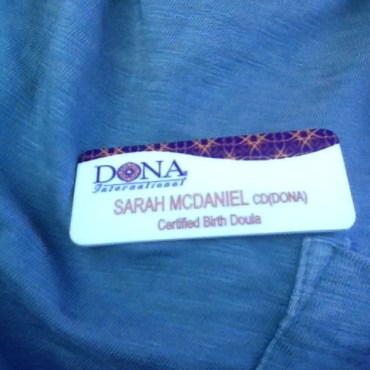
The day they sent my name tag in the mail, I wore it around the house all day. I truly love being a doula and I’m so looking forward to attending all the births I already have on the books for this year! It’s really exciting.
Welcome to my new website! I am so excited to be going to births again, starting now! I had to take a hiatus from attending births in 2015 to give my two precious babies some extra mommy love. I am overjoyed to announce that Evan is cancer-free and is not expected to have any more recurrence of his sarcoma on his head. He has been so excited to start Mother’s Day Out, in downtown NB, and his doctor has given him the thumbs up to go! Yay! Eylah is moments away from walking and wants to do everything big brother is doing. Brian just got accepted to Tyndale Theological Seminary in Dallas and will be working on his Master’s of Messianic Studies. We feel so blessed to be entering a new season and are so excited to see what God has in store.
So that’s my update. If you have any questions about doula services please give me a shout via phone or email… I love to chat about babies!